Social media & content
Rebranding in 2026: Cost, Process & Checklist (incl. SEO)
Rebranding cost in 2026: published price ranges, EU trade mark checks at EUIPO, a six-phase process and a rollout checklist for SEO, Google profiles and AI search.
Key takeaways
In short:
- Cost: Published agency prices put a full rebrand with strategy and design system mostly at €10,000–60,000. The median across 1,000 Sortlist projects is $24,500. A refresh starts at a few thousand euros (sources below).
- Hidden main cost: Rolling the brand out to the website, templates, signage, vehicles and print accounts for around 50% of the budget in Sortlist's planning model. Identity design is only about 20%.
- Process: Audit, strategy, naming and legal clearance, design system, rollout, monitoring. Three to six months for strategy and identity is typical.
- Before launch: Clear the trade mark (EU trade mark from €850 at EUIPO; German national mark from €290 for up to three classes). Update company register entries and legal notices, and review all claims under the EmpCo rules in force since 27 September 2026.
- Digital: Switch redirects, Google Business Profile, structured data, Wikidata and directories at the same time. Then check whether AI assistants still use the old name.
Rebranding is the fundamental realignment of an existing brand: positioning, visual and verbal identity and sometimes the name change. That sets it apart from brand building, where a brand is developed systematically for the first time. A rebrand has to carry over existing awareness, rankings and customer relationships. That is exactly where projects fail when they are planned as pure design work.
This guide covers what a rebrand costs in 2026, how the process works and what teams forget during rollout. That includes Google Business Profile, Wikidata, structured data and whether ChatGPT and other assistants still return the old name. It takes a European view: EU trade marks at the EUIPO, EU consumer law and, as an example, German company-law formalities. Status: November 2026.
When is a rebrand justified, and when is a refresh enough?
A rebrand pays off when the current brand actively holds the business back. "The team is tired of the logo" is not a good reason. Typical triggers are:
- Merger or acquisition: Two brands must be combined into one brand architecture. Often one brand is absorbed into the other, or a new umbrella name is created.
- Repositioning: The offering, audience or price segment has changed, but the brand still communicates the starting point.
- Outdated identity with a consistency problem: Several logo versions, inconsistent colours, no design rules.
- Legal conflict: An earlier trade mark right clashes with your name. Renaming is then often no longer optional.
- Expansion: The name is hard to pronounce, misleading or already protected in the target market. With 27 EU member states and many languages, this is a common trigger for European companies.
A refresh is enough when positioning and name still work and only the look needs modernising. The rule of thumb: if the problem is "we look dated", a refresh usually does it. If it is "nobody understands what we do today" or "the name holds us back", you are talking about a rebrand.
What types of rebranding are there?
The terms are used loosely. For budgeting, this classification by scope helps:
| Type | What changes | Typical cost drivers |
|---|---|---|
| Refresh | Logo refinement, colours, typography, imagery; name and positioning stay | Number of templates and applications, print runs, website adjustments |
| Partial rebrand | New positioning or messaging, visual evolution; name stays | Strategy workshops, audience research, new copy on all channels |
| Full rebrand | Positioning, identity, design system, tone of voice | Strategy, design system, rollout across all touchpoints, internal launch |
| Renaming | Also a new name, often a new domain | Naming, trade mark search and filing, company register, domain move, signage, vehicles, contracts |
The further down the table, the larger the share of rollout and legal costs compared with design.
How much does a rebrand cost in 2026?
There is no fixed market price, but some providers publish ranges. The overview below uses only sources with concrete numbers (as of November 2026; sources do not always state whether prices include VAT):
| Source | Scope | Published range |
|---|---|---|
| Sortlist, analysis of 1,000 projects | Rebranding projects via the platform | $10,000–60,000, median $24,500 |
| TWOSEE (German agency), market prices as stated by the agency | Brand refresh (logo, colours, fonts) | €4,000–15,000 |
| same | Full rebrand incl. strategy & design system | €10,000–60,000 |
| same | Relaunch incl. website & marketing | €19,000–100,000+ |
| dp.vision (Polish studio serving DACH) | Freelancer / boutique studio / network agency | €2,000–15,000 / €10,000–40,000 / from approx. €25,000 |
| Frontify (brand software vendor) | Enterprise refresh / reboot / overhaul | $50,000–100,000 / $100,000–250,000 / $250,000–1,000,000+ |
| Contentoren | Rebrand (strategy, identity, migration planning) | from €15,000 incl. VAT; rollout quoted separately by scope |
| Contentoren | Brand building | from €7,500 incl. VAT |
Agency figures are self-reported. They are a guide, not a benchmark. Frontify's ranges come from projects run on its own software and target large companies. All Contentoren prices are on our pricing page.
Where does the budget go?
Based on its project data, Sortlist proposes a split by phase: about 5% research, 15% strategy, 20% identity and design, 50% applying the brand to materials and 10% launch and rollout. If you only budget for the new logo, you have not seen most of the bill. Frontify also recommends a contingency of 10–15% for extra creative rounds and regulatory changes.
Internal change-over costs no agency quote includes
You usually pay these directly to printers, sign makers or other suppliers, so plan them separately from the agency budget:
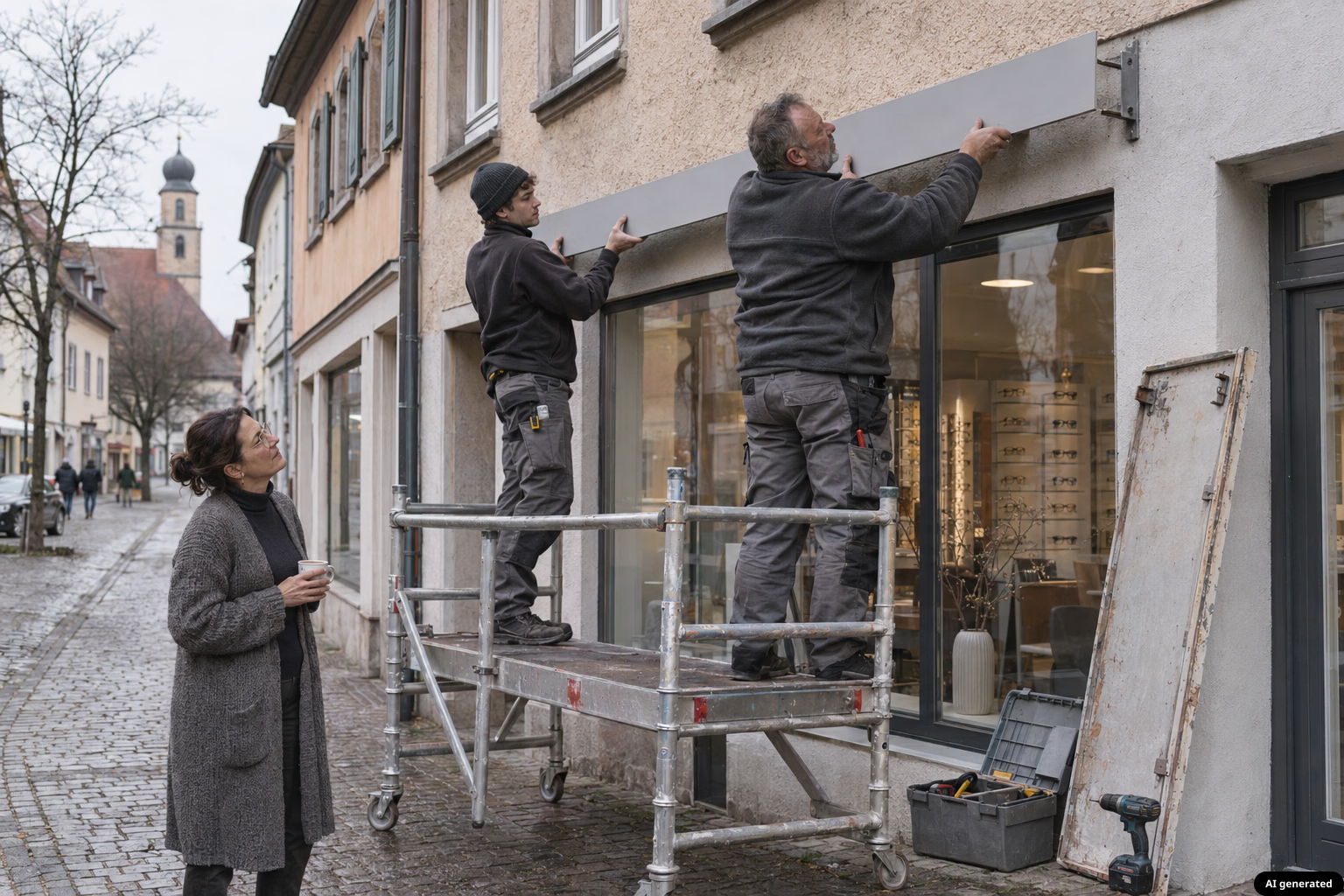
- Signage and outdoor advertising: building signs, illuminated signs, wayfinding. Depending on the country and municipality, illuminated or large signs may need a permit.
- Vehicles: lettering or wrapping the fleet.
- Workwear and merchandise.
- Print: business cards, letterheads, forms, brochures, packaging, stamps. Leftover stock with the old name has to be written off.
- Digital assets: website, presentation and document templates, email signatures, newsletter templates, social media graphics, videos, app icons.
- Formalities: company register changes, trade mark filings, domains, updates to contracts, terms and bank details.
- Internal time: workshops, approvals, training. This effort is real even if it never shows up on an invoice.
The more physical touchpoints a company has, the heavier this block weighs. For a consultancy with a website and business cards it is small. For a trades business with a vehicle fleet and branches, it can exceed the agency fee.
How do you clear trade marks, domains and social handles?
Check that a new name is legally available before it wins fans internally. Having to withdraw a name after launch because of a cease-and-desist letter is the most expensive mistake in the whole project.
Step 1: Your own preliminary search (free)
- TMview: This database, linked by the EUIPO, holds trade marks from all EU national offices, the EUIPO and many offices outside the EU. It is the best starting point for a pan-European search.
- National registers: For example the free DPMAregister in Germany. It also contains EU trade marks and international registrations designating Germany or the EU.
- Company names: Unregistered business names can also create earlier rights. The German office, for instance, explicitly lists them as a possible basis for opposition. Check company registers in your key markets.
- Domains and handles: Check the main domain extensions (your country codes plus .eu and .com) and profile names on LinkedIn, Instagram, YouTube, TikTok and other relevant platforms. Secure them early.
A preliminary search finds identical marks. Whether similar signs for similar goods and services are likely to be confused is a legal assessment. Have a trade mark attorney do it before the final name decision.
Step 2: Filing with the EUIPO or a national office
| EU trade mark (EUIPO) | National mark, e.g. Germany (DPMA) | |
|---|---|---|
| Territory | all EU member states | one country |
| Filing fee | €850 online for one class, 2nd class €50, each class from the 3rd €150 | €290 online incl. up to three classes, each further class €100 |
| Term | 10 years, renewable | 10 years, renewable |
| Third-party opposition period | 3 months after publication of the application | 3 months after publication of the registration |
At filing, the EUIPO only examines absolute grounds for refusal, such as lack of distinctiveness. Earlier third-party rights only become relevant through opposition, and according to the EUIPO one in five EU trade mark applications is opposed. The opposition fee is €320. An EU trade mark is a single right: if it is successfully opposed on the basis of an earlier right in just one member state, the whole application can fail. That is why the TMview search matters. The German office keeps filing fees even if an application is withdrawn or refused, and it currently reports longer processing times in trade mark proceedings. According to the EUIPO, SMEs can get part of their filing fees reimbursed through the SME Fund, depending on the country. Check current conditions and deadlines there.
What does the rebranding process look like?
The durations in this table are typical for mid-sized projects. Small teams move faster, corporates slower.
| Phase | Content | Output | Typical duration |
|---|---|---|---|
| 1. Audit | Brand perception (customer interviews, surveys), competitors, inventory of all touchpoints, brand search volume and rankings as baseline | Refresh vs. rebrand decision, asset list | 2–6 weeks |
| 2. Strategy | Positioning, audiences, brand architecture, key messages | Strategy document signed off by leadership | 3–8 weeks |
| 3. Naming & legal clearance | Name options, linguistic checks across target languages, trade mark search, domain and handles | Approved, filed name | 4–8 weeks plus opposition period |
| 4. Design system | Logo, colours, typography, imagery, tone of voice, templates, guidelines | Brand guidelines and asset library | 6–12 weeks |
| 5. Rollout | Website, digital profiles, print, signage, vehicles, internal launch | New brand on all prioritised touchpoints | weeks to months |
| 6. Monitoring | Rankings, brand search, profiles, AI answers, recall | Fix list, final report | 3–12 months after launch |
For context, published agency figures give three to six months for boutique studios and four to nine months for network agencies. Frontify puts enterprise projects at five to ten months.
Rollout checklist: what needs to change online?
For search engines and AI systems, a name change is an entity change. Ideally, every source should describe the same company under the new name at the same time.
Website and domain
- If the domain changes: one-to-one redirects for every important URL. Our website redesign SEO checklist covers everything from URL inventory to go-live checks.
- Use the Search Console Change of Address tool. Google uses it to prioritise the new domain and forward signals for 180 days. Keep redirects active at least that long. Google also recommends paying for the old domain for at least a year so nobody else can take it over.
- Separate the domain move from a redesign if you can: Google advises keeping the site architecture the same so signals pass more directly.
- Titles, meta descriptions, footer, about page, favicon, Open Graph images: switch to the new name. Add a line "formerly [old name]" on the about page.
Structured data and entity
- Update
Organizationmarkup:name,logo,urlandsameAswith all official profiles. Google's Organization documentation recommends properties such asname,alternateName,legalNameandlogo. If the old name is still widely used, keep it asalternateNameduring the transition. - Wikidata: If an item exists, update the label and keep the old name as an alias. The "official name" property (P1448) accepts start and end time qualifiers. Follow Wikidata's sourcing and conflict-of-interest rules.
- Wikipedia: Do not edit it yourself. If an article exists, suggest the change on its talk page with a source such as a register entry or press release.
Profiles and directories
- Google Business Profile: Enter the name exactly as it appears on your signage, stationery and other branding. Slogans, keywords and other additions are not allowed under Google's guidelines. Google reviews edits before they go live, and if you change a verified business name you might need to verify again. Switch the profile only once the sign and website show the new name.
- Bing Places, Apple Business Connect and directories: national business directories, industry portals, review sites. Our guide to local AI search explains how to run a NAP audit.
- Social media profiles: names, handles, profile pictures, banners and bio links. Platforms have different rules for renaming company pages. Check each help centre in advance.
- Email signatures, auto-replies, sender names in your newsletter tool, calendar invites and video call backgrounds.
- Ad accounts: ad copy, brand names in Google Ads and Meta, merchant accounts. Some require advertiser re-verification.
AI search: do ChatGPT and co. know the new name?
AI assistants build answers from training data, web search and directories. After a name change, they often keep returning the old name or mixing both for weeks or months. What helps is a consistent data footprint (see above) and a clear press release that mentions both the old and new name. Test regularly with a fixed set of prompts in ChatGPT, Gemini, Copilot and Perplexity, for example "What does [new name] do?", "Who is [old name]?" and "Recommend a provider of [service] in [city]". Log the answers with dates.
What legal points apply?
This section is not legal advice; it lists what to check. The company-law examples are German. Other EU countries have equivalent rules on register entries, business letters and website identification.
EU-wide: claims and sustainability labels (EmpCo): Directive (EU) 2024/825 has applied since 27 September 2026 in all member states. Among other things, it adds to the blacklist of unfair practices:
- sustainability labels not based on a certification scheme or set by public authorities;
- generic environmental claims without proof of recognised excellent environmental performance;
- claims that a product is climate-neutral based on offsetting.
National transposition laws implement it, in Germany the Third Act amending the Unfair Competition Act (UWG). A rebrand is the right moment to review every slogan, claim and self-designed label in the new design system. Germany's transitional rule in § 15b UWG, as explained by the Chamber of Commerce (IHK) Südlicher Oberrhein, only covers goods placed on the market before 27 September 2026, until 26 September 2028. It does not cover new marketing materials for a new brand.
Company register (Germany): A change of company name must be filed for registration under § 31 HGB, electronically and publicly certified (§ 12 HGB), usually via a notary.
Business letters (Germany): Under § 37a HGB, the company name, legal form, registered office, register court and number must appear on business letters, including emails to specific recipients.
Legal notice / Impressum (Germany): Under § 5 DDG, name, address and, for legal entities, legal form and authorised representatives must be easy to find. The same applies to social profiles that link to a legal notice.
Contracts and IP: Move licences, supplier contracts, terms and bank details to the new company name. Do not let old trade marks lapse too early while they still protect value or remaining stock.
How do you bring employees and customers along?
A rebrand only works if your own people carry it. This sequence has proven itself:
- Leadership first: explain the reasons, strategy and timeline before rumours start.
- Internal launch before external launch: every employee hears the new name before customers and press do, with an FAQ and talking points for customer conversations.
- Make templates and guidelines available: without ready-made templates, teams build their own versions and the consistency problem comes back.
- Inform customers actively: a mailing to existing customers with old and new name, new contact details and what does not change (contacts, contracts, terms).
- Include employer branding: job ads, careers page, employer profiles on LinkedIn, Glassdoor and local platforms, and employees' own profiles (employer name).
What do recent rebrand examples show?
The best-known recent example is Jaguar. On 19 November 2024, JLR unveiled a new identity with new logo, typeface and colour palette ahead of the brand's relaunch as an electric-only marque. According to Wikipedia's summary of the coverage, reactions were sharply polarised. Critics pointed to alienating existing customers; others praised the huge attention. The lesson for SMEs: a radical break buys reach but also resistance from existing customers. The more your business depends on regulars, the more you need continuity signals such as colours, imagery and a clear reference to the old name.
How do you measure success?
Set baselines during the audit, or you will have nothing to compare against.
| KPI | How to measure | What to watch |
|---|---|---|
| Brand search volume | Search Console branded queries filter (available to all eligible sites since March 2026) | Look at old and new brand queries together; the transition takes months |
| Direct traffic | Web analytics, "Direct" channel | A drop after a domain move points to missing redirects or old printed material |
| Rankings and organic clicks | Search Console before/after | Temporary fluctuation is normal; judge the trend over 3–6 months |
| Prompted and unprompted recall | Short survey among customers or target audience before and after launch | Use the same questions and sampling logic |
| Consistency | Spot-check audit of all profiles and directories | Share of sources showing the new name |
| AI answers | Fixed prompt set, monthly | How often does the old name still appear? |
| Leads and applications | CRM, applicant tracking | Business impact, not just design praise |
Common rebranding mistakes
- Design before strategy: a new logo does not fix a positioning problem.
- Falling for a name before clearing it: the trade mark search comes after internal presentations, and disappointment follows.
- Budgeting only the agency fee: rollout, signage and internal time are missing from the plan.
- Domain move without a redirect plan: rankings and backlinks are lost.
- Renaming the Google profile too early: the profile name does not match the sign on site, which can complicate verification.
- Carrying old claims into the new design: environmental claims and labels not reviewed against the new EU rules.
- Employees learn about it from the press: if you do not inform them first, you lose your most important ambassadors.
- No monitoring: old directory entries and AI answers with the wrong name persist for months.
Conclusion
A rebrand is a change project with a design component, not a design project. Published ranges of €10,000 to €60,000 for a full rebrand give a frame of reference. The largest cost block, though, is often rolling the brand out to every touchpoint plus internal time. If you plan trade mark clearance, legal review and digital migration from day one, you protect rankings, awareness and customer relationships.
Contentoren supports rebrands from audit and strategy through the design system to SEO and digital migration. If you first need to build a brand, start with brand building. Whether your situation calls for a rebrand, an evolution or just more consistency is something we can clarify in a no-obligation conversation: get in touch.
Sources
Accessed 6 November 2026
- Sortlist: Rebranding Kosten: Budget für Ihr Unternehmen sicher planen (published 13 Oct 2026) – 1,000 projects, $10,000–60,000, median $24,500, budget split by phase.
- TWOSEE: Was kostet ein Rebranding? Preise, Faktoren und realistische Budgets (6 Jul 2026) – market prices by scope as stated by the agency.
- dp.vision: Rebranding 2026: wann es sich lohnt, was es kostet und wie es abläuft – ranges and timeframes by provider type.
- Frontify: Rebranding costs: what to budget and how to plan – enterprise ranges, 10–15% contingency, timelines.
- EUIPO: Fees and payments; Availability / TMview; Examination; Opposition; SME Fund.
- DPMA (German Patent and Trade Mark Office): Trade mark fees (status 29 Sep 2026); DPMAregister; Opposition and cancellation.
- Google: Change of Address tool; Organization structured data; Business Profile guidelines; Edit your Business Profile; Branded queries filter.
- Wikidata: Help:Aliases; Property P1448 "official name".
- EUR-Lex: Directive (EU) 2024/825 (EmpCo) – applies from 27 Sep 2026; annex with new blacklist points.
- German Federal Ministry of Justice (BMJV): Third Act amending the UWG (BGBl. 2026 I No. 43).
- IHK Südlicher Oberrhein: Umsetzung der EmpCo-Richtlinie gegen „Greenwashing“ – § 15b UWG transitional rule until 26 Sep 2028.
- German law (gesetze-im-internet.de): § 12 HGB, § 31 HGB, § 37a HGB, § 5 DDG.
- JLR Media: Jaguar reimagined (19 Nov 2024); Wikipedia: Jaguar Cars.
Frequently asked questions
How much does a rebrand cost in 2026?
Published agency ranges in Germany put a full rebrand with strategy and design system mostly between €10,000 and €60,000, while a pure brand refresh starts at a few thousand euros. A Sortlist analysis of 1,000 projects reports budgets of $10,000 to $60,000 with a median of $24,500. On top come internal change-over costs for signage, print, vehicles and digital assets, which are often the largest block.
How long does a rebrand take?
Strategy and the new identity typically take three to six months, longer in larger organisations. Rolling the brand out across all touchpoints follows over weeks to months. Trade mark filings run in parallel and can add time because of the three-month opposition periods at EUIPO and national offices.
How do I check whether a new brand name is available in the EU?
Start with free searches in TMview, which covers the registers of all EU national offices, the EUIPO and many non-EU offices, plus the national register of your home market. Also check company registers, domains and social media handles. Because similar marks can conflict too, have a trade mark attorney assess the results before you commit to a name.
Will a rebrand hurt my Google rankings?
A name change on its own does not cost rankings, but a domain move without clean redirects does. Plan one-to-one redirects, use the Search Console Change of Address tool for a domain move and keep paying for the old domain for at least a year. Google notes that rankings can fluctuate temporarily during a site move.
What does the EU EmpCo Directive mean for a rebrand?
Since 27 September 2026, stricter EU rules apply to environmental claims and sustainability labels. If your rebrand introduces new claims, slogans or self-designed labels, have them reviewed before launch. Generic environmental claims without recognised proof and sustainability labels not based on a certification scheme are now on the blacklist of banned practices.
Keep reading
Related articles

Social media & content
AI Content Marketing 2026: Workflow, Quality & AI Visibility
AI content marketing strategy for 2026: a human-in-the-loop workflow, Google's AI content rules, citable formats, EU labelling, multilingual content and costs.
Read
Social media & content
Corporate Influencer Programme on LinkedIn: 2026 Guide
How to build an employee advocacy / corporate influencer programme on LinkedIn: roles, guidelines, AI rules, time budget, Thought Leader Ads, KPIs, 90-day plan.
Read
Social media & content
Email Marketing 2026/27: Newsletters in the Age of AI Inboxes
Email marketing trends 2026/27: what Gmail AI, Apple Intelligence and new sender rules mean for European newsletters – KPIs, deliverability, law, 90-day plan.
Read